
Most people believe that discipline is a personal trait.
That if you just had more willpower, more motivation, or more self-control, you would finally stay consistent with the habits you already know matter—exercise, nutrition, and sleep.
This belief is understandable.
It’s also wrong.
Psychological research, behavioral science, and decades of real-world observation point to a different conclusion:
Human beings are far more consistent when they are accountable to others than when they are accountable only to themselves.
This isn’t a flaw.
It’s how humans are wired.
And it’s the reason Discipline Monster exists.
The Psychological Reality of Accountability
Decades of research in psychology and behavioral science point to a simple truth:
Accountability works best when it is social, visible, and recurring.
When people know that:
- Someone else will ask how they’re doing
- Progress will be reviewed
- Commitments are not private
Follow-through increases dramatically.
This is tied to well-established principles in psychology such as commitment and consistency. When we make commitments that exist outside our own internal dialogue, we experience a natural desire to behave in ways that align with those commitments.
Research on commitment and consistency has been popularized by Robert Cialdini and supported by findings from the Association for Talent Development (formerly the American Society for Training & Development).
In contrast, self-accountability lives entirely inside our own head—where stress, fatigue, rationalization, and distraction are always competing for attention.
That internal negotiation is exhausting.
And eventually, it breaks down.
Why Self-Accountability Breaks Down in Real Life
Self-accountability sounds noble.
In practice, it fails for predictable reasons—especially for busy professionals.
When life gets demanding:
- Willpower fluctuates
- Motivation disappears
- Decision fatigue increases
- Priorities collide
When accountability is purely internal, it becomes easy to:
- Lower standards quietly
- Skip tracking “just this week”
- Justify inconsistency
- Delay reflection indefinitely
Nothing bad happens immediately when you stop holding yourself accountable.
And that’s the problem.
External Accountability Reduces Cognitive Load
Accountability to others removes friction instead of adding it.
It replaces:
“Do I feel like doing this today?”
with:
“I said I would.”
That single shift matters more than most people realize.
External accountability:
- Reduces emotional decision-making
- Removes constant self-negotiation
- Creates a predictable rhythm
- Turns intention into structure
This is why group fitness works better than solo workouts.
Why study groups outperform self-study.
Why peer accountability works across education, leadership, and behavior change.
Humans do better when they don’t do hard things alone.
Even Discipline Is Easier With Others
I say this as someone who is comfortable with discipline.
I’ve built systems.
I understand consistency.
I’ve trained myself to show up over decades.
And still—being accountable to others makes consistency easier and more enjoyable.
Not because I lack discipline.
But because discipline is easier when it’s supported by structure and community.
Isolation adds friction.
Shared rhythm removes it.
That insight shaped everything about Discipline Monster.
Why Discipline Monster Is Built Around One Weekly Ritual
When I looked at existing health and coaching programs, I noticed a pattern.
Many of them are:
- Intrusive
- Time-intensive
- Expensive
- Difficult to sustain long-term
One-on-one coaching requires full engagement every session.
Executive programs demand deep time blocks and rigid schedules.
Even when they’re effective, they’re hard to maintain consistently.
That wasn’t what I wanted.
I wanted a system that:
- Respected real schedules
- Survived travel and stress
- Required minimal effort to maintain
- Could be sustained for decades
So Discipline Monster was built around one simple ritual:
A Weekly Accountability Livestream
- Same day every week (Sunday)
- Same time
- Attend live or watch the replay
- Participate actively or quietly
- Stay for the full session or just ten minutes
No pressure.
No performance.
No obligation to share.
Just a place to show up.
Why Sundays Matter for Accountability
Sunday is a natural pause point for most professionals.
It’s often:
- Less reactive
- More reflective
- Mentally quieter
- A bridge between weeks
That makes it the perfect time to:
- Take inventory
- Review consistency
- Reset expectations
- Re-anchor habits
The livestream exists to make that weekly check-in automatic.
The Weekly Accountability Sheet (What It Is and What It Isn’t)
At the center of the weekly livestream is a simple tool:
The Weekly Accountability Sheet
It tracks three foundational behaviors:
- Exercise
- Nutrition
- Sleep
Each day is scored:
- 3 = goal achieved
- 2 = partial effort
- 1 = minimum standard not met
At the end of the week, you see your pattern—not perfection, not failure, just reality.
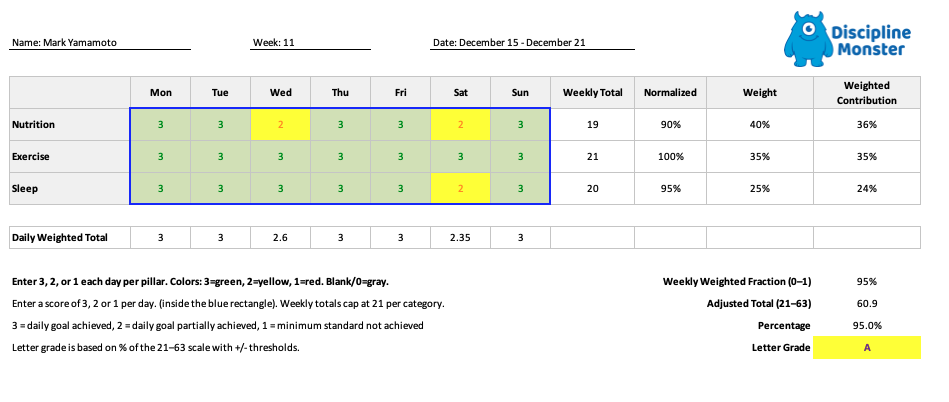
“The Weekly Accountability Sheet — a simple visual inventory of consistency, not perfection.”
The Sheet Is Not the Value
The sheet itself is not the value.
The real value is what it anchors.
It creates a reason to:
- Show up once per week
- Review behavior honestly
- Stay connected to a shared rhythm
- Maintain visibility over time
The livestream gives that ritual a home.
You don’t need to speak.
You don’t need to perform.
You don’t need to explain yourself.
You just show up.
Even for ten minutes.
Why the Ritual Matters More Than Participation
Participation is optional.
The ritual is not.
The act of showing up—live or via replay—creates continuity.
Over time, that continuity:
- Stabilizes habits
- Prevents drift
- Reduces the chance of quietly quitting
- Makes consistency feel normal instead of heroic
This is accountability without intrusion.
Why This Model Works for Busy Professionals
Busy professionals don’t need:
- More information
- More intensity
- More pressure
They need:
- Low-friction systems
- Predictable touchpoints
- Structures that survive bad weeks
- Accountability that doesn’t demand constant energy
Discipline Monster was designed around those realities.
Not motivation.
Not willpower.
Final Thought: Accountability Aligns With Human Psychology
If self-accountability were enough, most people wouldn’t struggle with consistency.
But humans aren’t machines.
And discipline isn’t a personality trait.
Accountability to others works better than accountability to yourself because it aligns with human psychology, not against it.
The tool is simple.
The ritual is everything.
And showing up—quietly, imperfectly, consistently—is what changes outcomes over time.
That’s the system.
And it works.
Want to Build Discipline Without Relying on Motivation?
I’ve put together a free Discipline Monster guide that explains:
- How discipline actually works in real life
- Why accountability matters more than information
- How to start using a simple system immediately
It also includes access to The Clarity Manifesto — a practical tool to help you define why your health and habits matter before you try to change anything.👉 Download the Clarity Manifesto and a Discipline Monster Free Guide that helps you define why discipline matters.
Build Discipline Without Motivation
Two free tools to help you build real discipline through structure, clarity, and accountability — without relying on willpower.
Free downloads • No motivation required